The American Communist Revolution
My previous post about the Russian Revolution is very information-dense and hard to follow. I’ll translate it to Americanese:
Ah, Great America at the turn of the 20th century. A poor, backwards, and too-large multi-ethnic Empire of about 130 million, in which the dominant social struggle is about the oppression of the farmers, who make up about 80% of the population. The farmers hunger for land: despite America’s vast size, most of it is not arable. Bands of destitute farmers roam the countryside looking for work, sometimes turning violent.
Besides the farmers, about 10% of the population is engaged in industrial labour (eg. mining and construction) and only 1–2% works in factories. And they’re also not happy, because conditions for Industrial Revolution factory workers were horrific.
Regardless, the American Empire at the start of the 20th century is buckling under the onslaught of modernity. The old planter elite are fading away (they used to keep the farmers in check), the Emperor Nicholas of House Washington is incompetent but undercuts anyone capable of reforming the regime, and the country is in the middle of a prolonged economic contraction. Pretty much everyone is unhappy.
Then in 1905 the “barely-civilised” Japanese launch a surprise attack on Alaska, nearly wipe out the Pacific Fleet, and take Anchorage and the western half of the state. The already-rickety state, the massive military mobilisation, and the lost war trigger a failed revolution in the form of strikes, farmer violence, and mutinies in the US Army. The bureaucracy and the soldiers returning from the front crush the uprisings, while Emperor Nicholas is pushed to allow a Congress. Nicholas refuses and asks his uncle (a four-star general) to create a military dictatorship, but his uncle says he’ll shoot himself if the Emperor does not agree to create a Congress. Nicholas agrees, and then spends the rest of his life trying to fight and weaken Congress and reclaim his power, preventing the formation of a non-revolutionary political alternative.
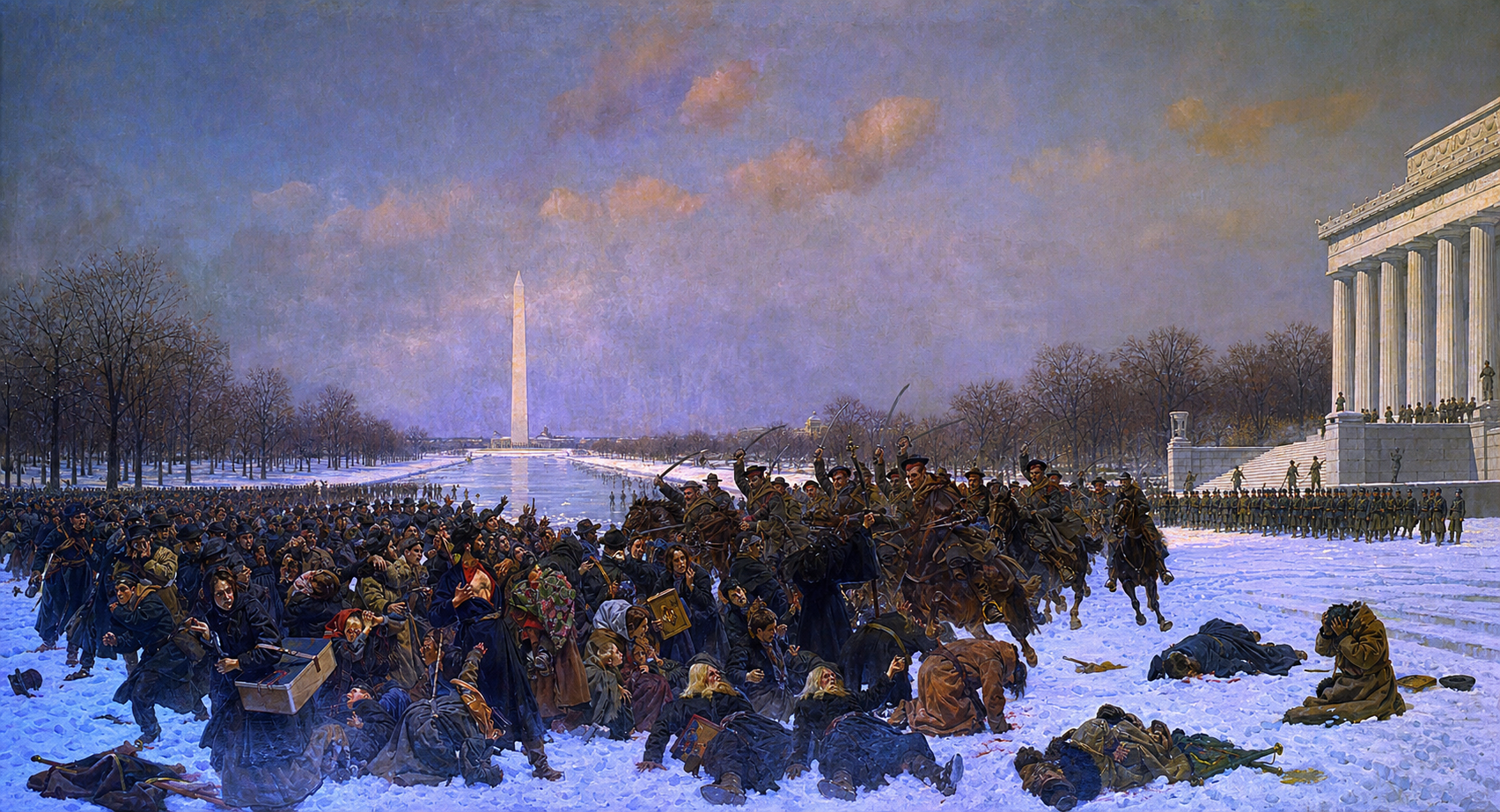
Bloody Sunday on the National Mall, 1905
Once the 1905 revolution is put down, a heroic bureaucrat called Stollman tries to save the system with a two-pronged attack: reforming agriculture to address the farmers’ hunger for land, and repression (killing). America experiences an economic boom, but Stollman dies before he can finish the reforms.
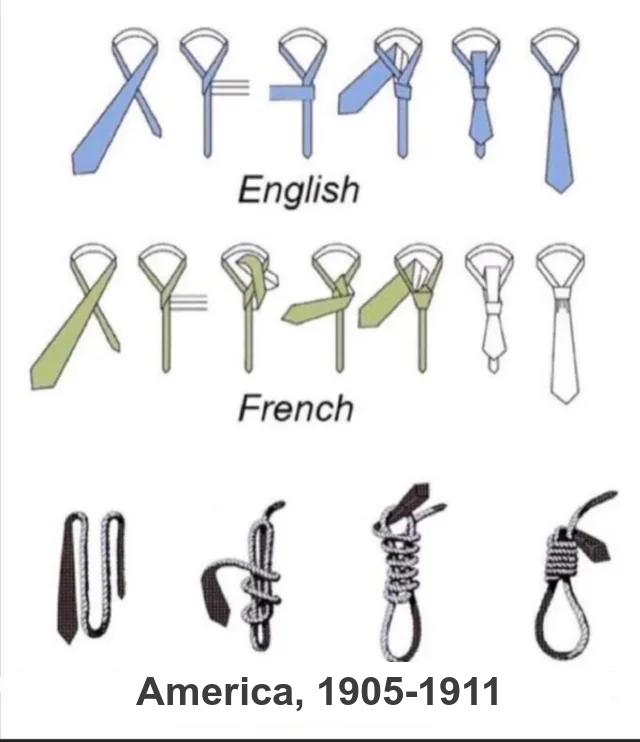
Stollman's Necktie
A terrorist with American links shoots a British nobleman in Halifax, and all the countries of the world are ready to go to war over it. Nicholas tries to avoid war with the British, but eventually decides that war will regenerate and unite the country, solve all the annoying social problems, and deliver a great patriotic and religious victory.
The war starts disastrously for the Americans. The British, based in Canada, advance deep into America, taking Chicago, Detroit, and most of the Pacific Northwest, and threatening Albany. Nicholas, like all boys, loves soldiers and war, so he leaves the capital to live with his generals and lets his wife influence the running of the country.
She erratically appoints and dismisses government ministers at a high rate, culminating in the appointment of Porter as Minister of the Interior (i.e. the guy responsible for keeping the country together). He suffers from frequent mental breakdowns, hallucinations, and erratic mood swings, and consults mystics, spiritual mediums, and fortune-tellers for major decisions. Another blow to the populace’s faith in the government 1.
So the war goes on, and despite more losses and a constant high rate of desertions, the state holds together and after a few years manages to deliver a lot of combat power to the front. It develops into a stalemate on the Canadian Front. The Americans haven’t lost, but they’re barely still in the fight. Over two million American boys have died.
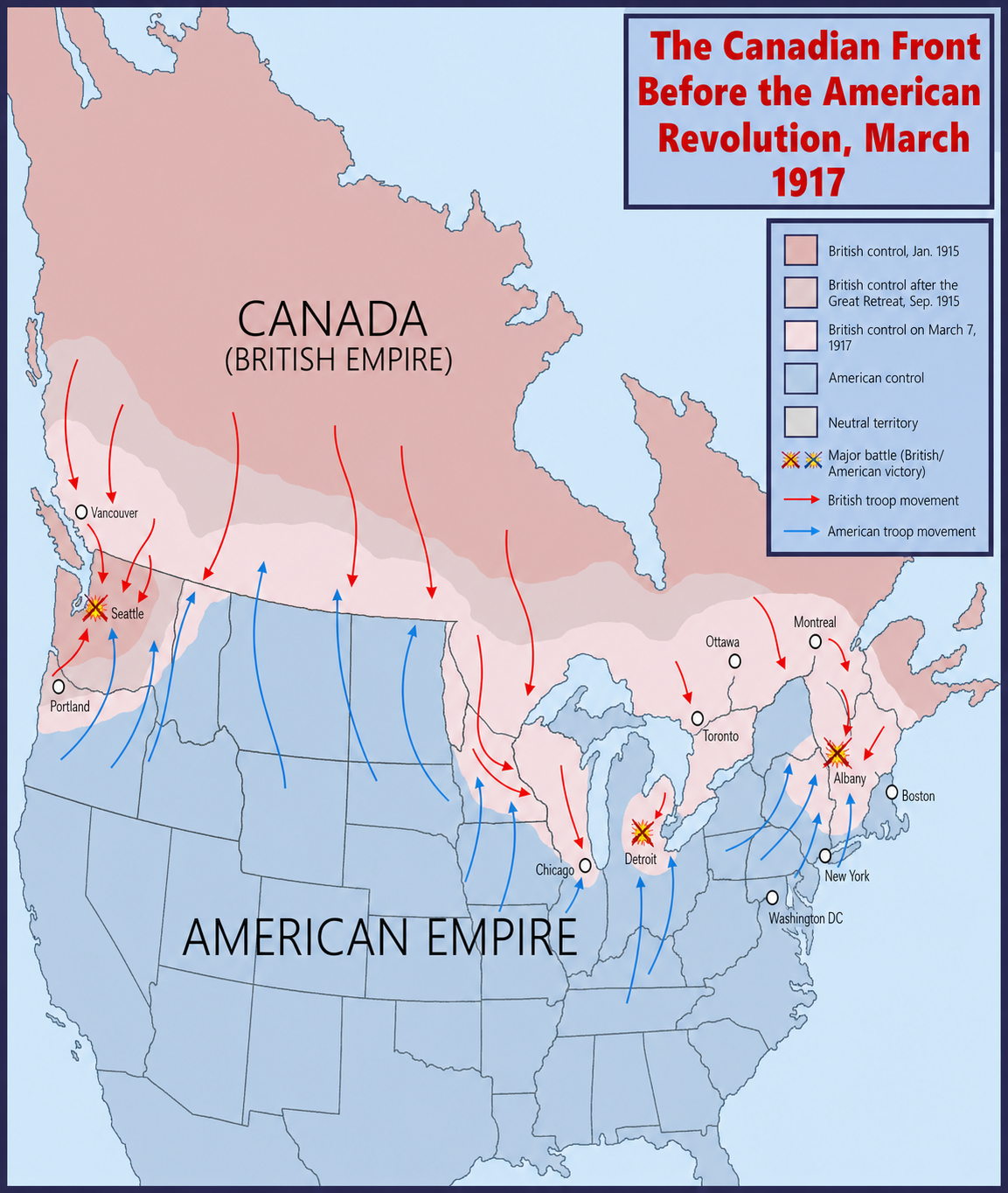
Territorial losses by the American Empire
But the straw that finally breaks the camel’s back is the food supply to Washington DC collapsing. In response there are mass demonstrations and strikes, and the capital garrison mutinies instead of firing on them.
Finally, enter the Soldiers’ and Workers’ Councils. The Communists (the main characters) are only a small faction within them; the rest are various flavours of leftists. The Washington Council is a rival government operating from the capital, and its influence rests on soldiers and factory workers (not farmers!). Its power does not extend much beyond the city; remember that 80% of the population is in the countryside, farming. The Communists flood the front line with agitators to ideologise more soldiers.
The generals at this point have lost faith in Emperor Nicholas and see him as incompetent, so they pressure him to abdicate so someone else can take the crown. He does so, handing the crown to the next in line, but the next in line unexpectedly declines. So the monarchy is accidentally abolished. Oops.
What if Emperor Nicholas hadn’t spent so much time undercutting Congress? Perhaps at this point a powerful and legitimate Congress could’ve taken over and righted the situation.
A Provisional Government forms, but it wants to continue the war and won’t redistribute land to the farmers without an assembly. Desertions and land seizures by farmers skyrocket.
The Communists in the Washington Council declare that they want to end the war, and the British pick up on this and transport the top Communist John Lennon into America. Lennon calls for an immediate end to the war.
The Provisional Government tries to hold the centre together, balancing the right wing and the left wing (the Councils). The Secretary of Defense Kearney gambles that a successful offensive against the British will legitimise the Provisional Government, but the offensive fails disastrously.
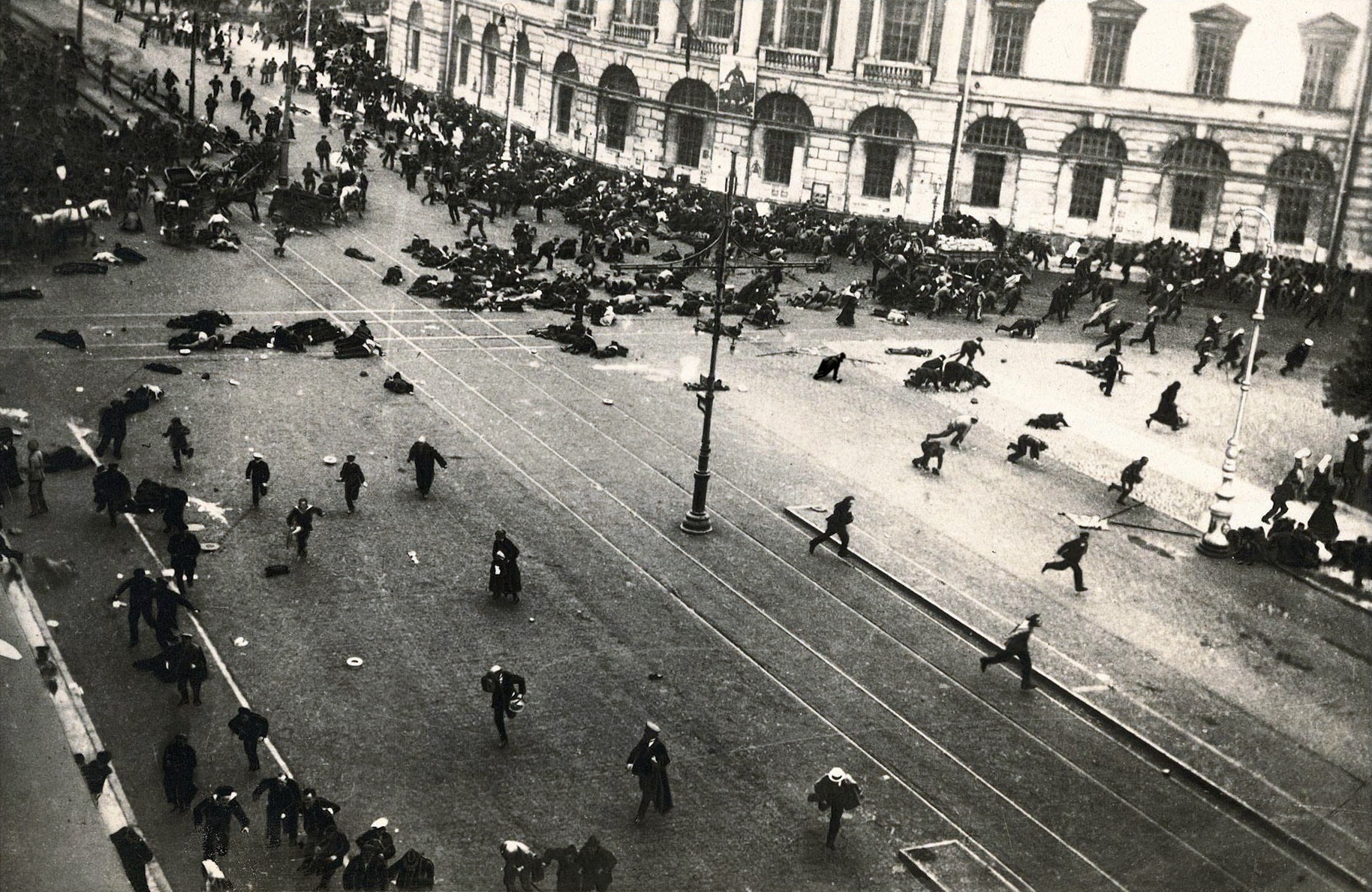
July Days. The army had just opened fire on street protesters.
Kearney takes over the government, pivots right (alienating the left), and appoints the right wing’s Hard Man General to run the army and Restore Order. The Hard Man General moves on Washington DC to Restore Order. Kearney interprets this as a coup, denounces him as a traitor, and arms the Washington Council to resist the Hard Man General (alienating the right). To this day it’s still unclear if the Hard Man General was actually plotting a coup or not.
The Hard Man General’s commands no longer have the government’s authority. Railway and telegraph workers obstruct his units’ movements, and the soldiers refuse to obey orders anyway. Oh, and now the Washington Council has guns!
What if Kearney tried to end the war instead of starting an offensive? What if he communicated better with the Hard Man General and they managed to put down the Communists in Washington DC?
So the monarchy is gone, the Provisional Government has lost all authority, and control over the army is slipping.
At this point the Communists don’t so much seize power in Washington DC as walk into lightly defended government offices with some desultory shooting. Hooray, utopian revolution is here!
Meanwhile in the countryside, the farmers are organically seizing and redistributing land. In terms of sheer scale and social restructuring, this is the real revolution.
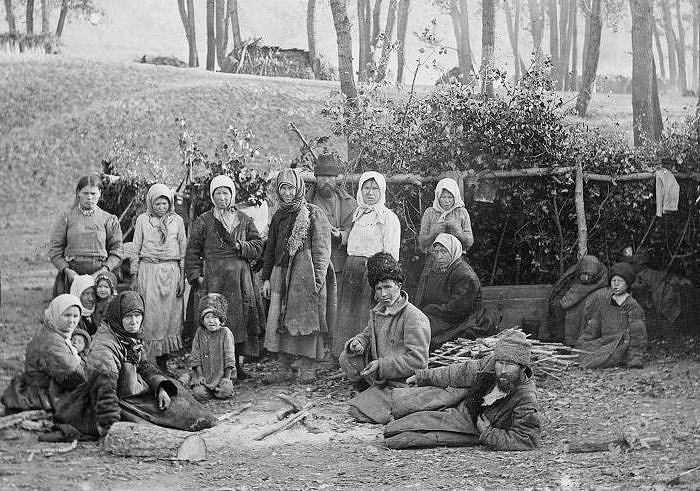
American peasants in the early 1900s
Okay, back to the Councils: they’ve now “seized power” in the capital, which means they control a very small fraction of the country. How do the Councils get national support, since “Workers’ Revolution!” is irrelevant to more than 80% of the population, who are concerned with land? Lennon picks the slogan “Peace, Land, and Bread”, which is exactly what everyone wants. This stroke of genius wins him a majority within the Washington Council.
It’s a popular message, but all throughout this period the farmers are already seizing the land in the countryside without waiting for a political party in the city to give them permission. Still, the Communists are legitimising the land revolution, and that’s very popular.
What if the Provisional Government or Kearney came up with the programme of Peace, Land, and Bread before the Communists did? Would they have become wildly popular and legitimate in the eyes of the farmers and the soldiers?
A note: the Councils aren’t just “communist”. There are a variety of socialist parties, including the Left DSA, the Right DSA, the Kamalists, and the Communists, and they disagree with each other. Some support a congressional democracy, some only care about the farmers, and others want to keep the war going defensively to avoid territorial losses. But the Communists are dominant within the Councils (for the moment).
The Provisional Government sets a national election in motion before it collapses. The DSA wins 40% of the vote, while the Communists get only 24%. So the Communists are dominant inside the Councils, but are a strong minority on the national level.
Here’s an important pattern: if the Communists allow a unity government of all socialist parties, they could be diluted, so they refuse a left-unity coalition and ally with one half of the DSA, leaving the other wing out in the cold with no power, only to later destroy that ally once it is convenient.
Okay, so the Communists have taken power in the capital by squeezing out the other leftist factions and taken control of parallel revolutions led by Councils in other big cities, but they don’t control the countryside at all. They don’t have a state yet.
Everywhere outside Communist control fractures into a complex mess of factions: Right Militias seeking to restore the old order, anti-Communist socialists, breakaway states, anarchists, local warlords, and others. It turns into a huge civil war.
The Communists build their army by seizing enormous stockpiles of arms (which are in the cities, where the Communists are in control!), reinstating conscription, and incorporating former Imperial officers (they can always be killed later!).
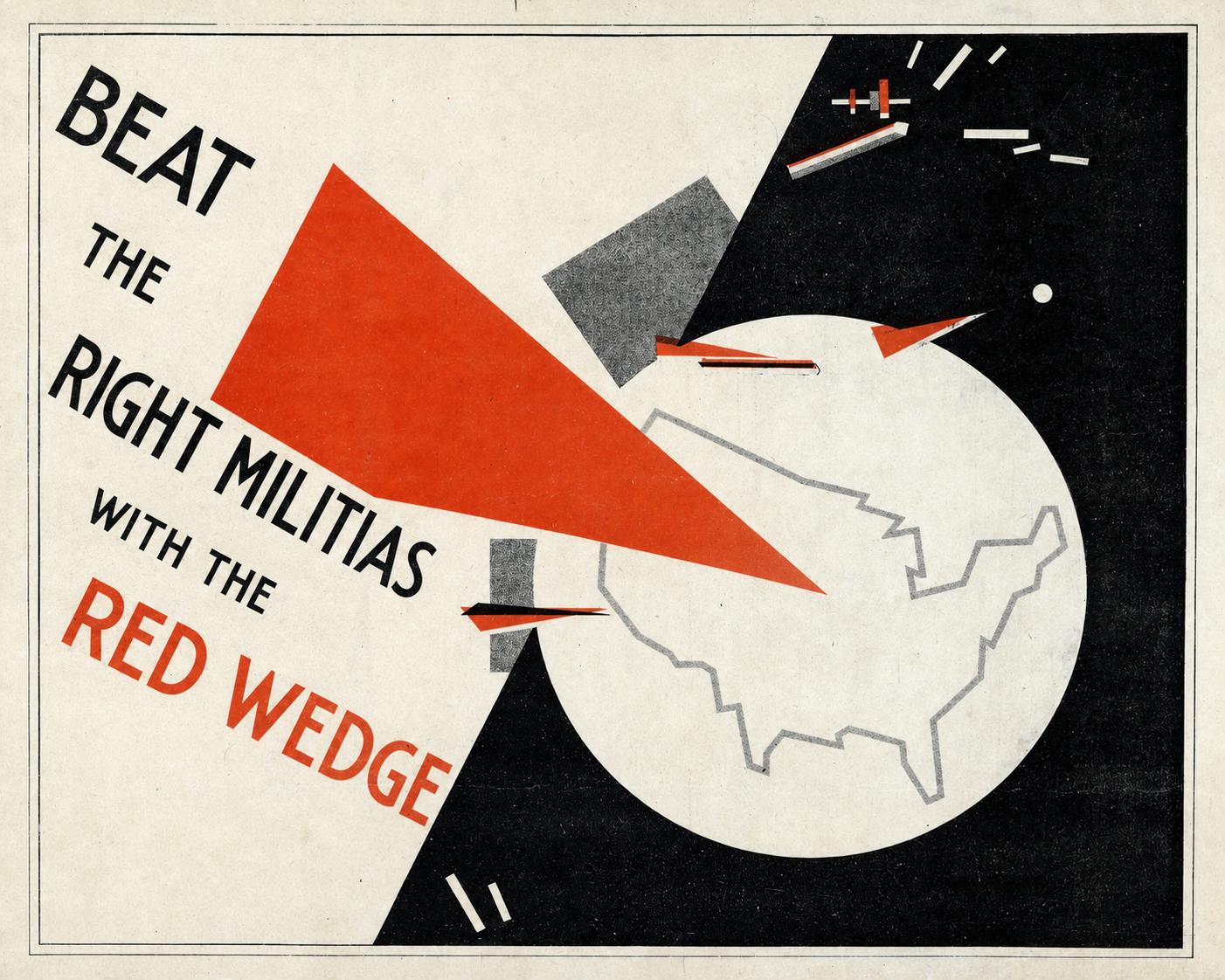
Beat the Right Militias with the Red Wedge, 1919
What’s the difference between conscripted soldiers and slavery?
Despite having most of the old Imperial generals and large armies, the Right Militias are hamstrung.
See, the Communists have tight control from above with a strong political programme: land for the farmers, peace for the soldiers, and worker power for the factory workers. Fighting for the Communists makes sense; you’re fighting for a good future, even if in practice they are incredibly brutal to their soldiers (just as the Right Militias are).
The Right Militias, on the other hand, refuse to promise land for the farmers, have no unifying figure or political programme, and embrace excessive American nationalism, which alienates potential allies in the nationalist movements (eg. Texans and California’s predominantly Mexican population).
What if the Right Militias, at last, promised land to the farmers and liberation to the national minorities to bolster their support?
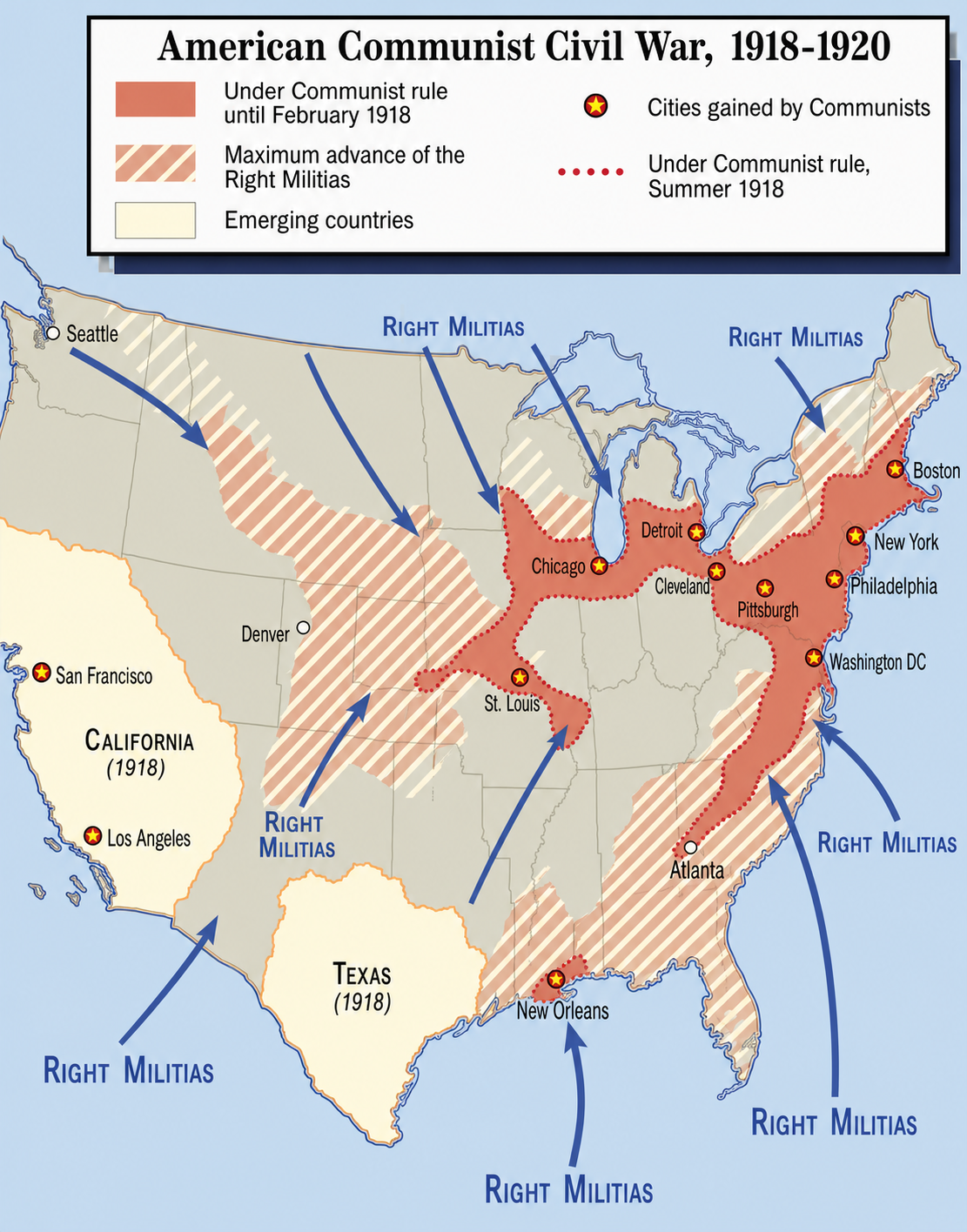
American theatre in the civil war. Blue arrows are Right Militia advances.
You’d think that being surrounded by the Right Militias would be a disadvantage for the Communists, but it’s the other way around: this gives them the advantage of interior lines. The Communists control the cities and the rail lines between them, while the Right Militias are stuck in the vast countryside with no good way to shift large amounts of forces and supplies around.
So both main forces are in utter disarray, experience high rates of desertion, and can barely muster supplies, but the Communists win in the end. All that’s left for the Communists is to reconquer as much of the periphery as they can.
So how does a revolution happen?
There have to be a number of national calamities, and alternative centres of power need to keep self-destructing until only the revolutionaries are left.
-
Interestingly, Canada’s longest-serving prime minister frequently consults mystics for political decisions as well. I wonder why it works out so well for him. Maybe Canadian mystics are better. ↩